
Authors: Teng Li & Francesca Giardini, Department of Sociology/ICS, University of Groningen.
How do vulnerability, as represented by health literacy, and social influence affect how people react during a health crisis? And how do various communication strategies impact adherence to public health guidelines?
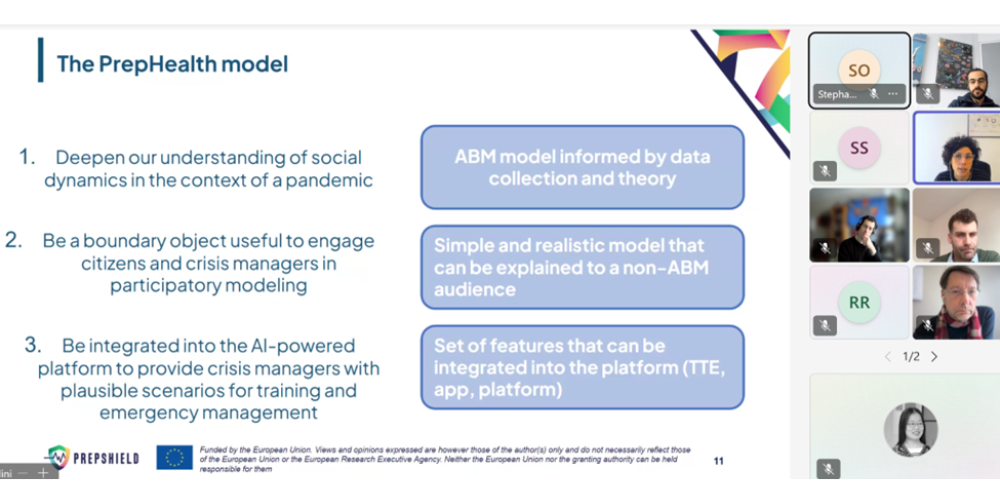
The study, titled “Unraveling the Role of Vulnerability and Norm Compliance in Societal Preparedness in Health Crises”, dives into these questions using PrepHealth, an Agent-Based Model (ABM) created as part of the PREPSHIELD project.
Understanding complex social dynamics
PrepHealth models how individuals with diverse backgrounds engage and respond to health crisis measures. It makes a distinction between vunerable and non-vulnerable individuals, considering aspects like health literacy, risk tolerance, social networks, social influence and how people inetract with institutions.
This simulation explores how social interactions can shape individual behaviors and looks at how different communication and intervention methods might impact compliance with public health guidelines.
This method is crucial for grasping health crises as complex social occurences, where personal choices are driven not just by individual views but also by interactions with others and institutions.
What did the simulations reveal?
The simulations brought to light several key dynamics.
Without any institutional intervention, opinions often aligned towards the initial majority viewpoint. When vulnerable individuals with less health literacy made up the majority, the overall compliance in the model dropped. On the flip side, if non-vulnerable individuals with higher health literacy were the majority, the model suggested a rise in compliance levels.
The simulations also analysed various communication techniques. Fear-based messaging might boost compliance quickly, but that effect tends to fade. On the other hand, trust-building strategies led to more lasting compliance under the studied conditions.
Interestingly, the model indicated that higher trust levels could speed up the acceptance of recommendations, though in some cases, high trust with limited institutional outreach might initially cause more division before opinions eventually aligned.
Enhancing inclusive preparedness
These insights stress the need to account for population diversity when gearing up for and managing health crises. Different groups have unique levels of health literacy, varying access to information, and distinct ways they engage with institutions and social networks.
The study highlights the urgency of boosting health literacy, especially among vulnerable populations, while making sure that crisis communications also reach those less connected to institutional messaging channels.
Instead of a one-size-fits-all approach, grasping these differences can help create more focused and inclusive preparedness strategies.
Moving from modelling to future applications
PrepHealth is still being refined, and future development will add more elements like cognitive biases, risk perception, and social influence mechanisms. The model’s growth and validation will also involve surveys, interviews, stakeholder feedback, and real-world observations.
This ongoing work aims to better represent complex behavioral and social dynamics as we prepare for future health emergencies.
Contributing to PREPSHIELD’s approach
This publication plays a part in PREPSHIELD’s larger mission to establish more inclusive, evidence-based and citizen-focused strategies for health crisis preparedness. By utilizing agent-based modeling to investigate how vulnerability, health literacy, social interactions and institutional actions shape collective behaviour, the study offers another angle on the complexity of societal preparedness.


 English
  Italian
  Romanian
  German