
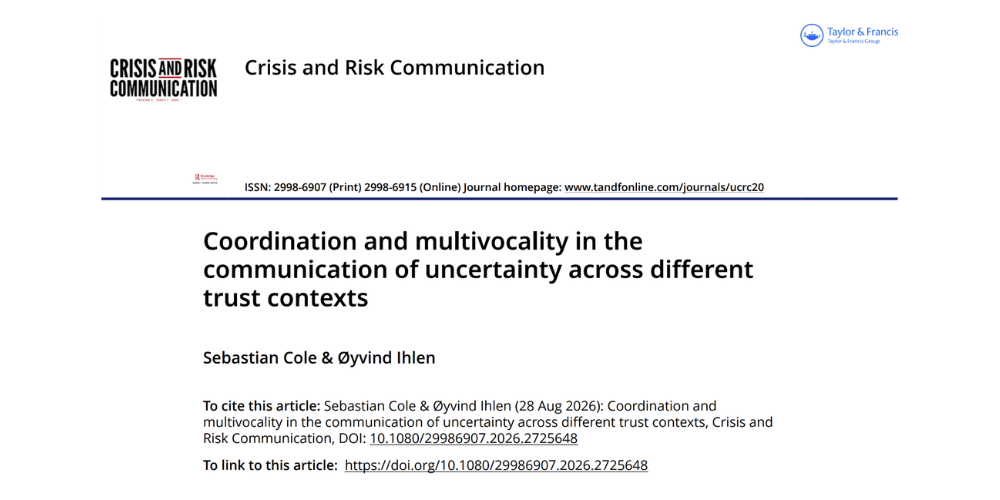
Authors: Sebastian Cole & Øyvind Ihlen, Department of Media and Communication, University of Oslo, Oslo, Norway
How should public authorities communicate when scientifc knowledge is evolving and uncertainty is unavoidable? And how can different organisations coordinate their messages while still addressing the diverse needs and expectations of citizens?
A new scientific publication developed within the PREPSHIELD project explores these questions, focusing on how uncertainty is communicated across different national and institutional contexts.
Communicating uncertainty in times of crisis
During a health crisis, decision-makers often need to communicate information before all the facts are known. As evidence develops, recommendations may change, creating a challenging communication environment for authorities, experts, healthcare professionals, and other stakehoders.
The publication, “Coordination and multivocality in the communication of uncertainty across different trust contexts“, examines how actors involved in crisis communication navigate these challenges.
Rather than focusing solely on delivering a single, consistent message, the research explores the importance of coordination between different voices involved in communicating during a crisis. This is particularly relevant in complex emergencies, where national and local authporities, scientific experts, healthcare organisations, and community actors may all contribute to public communication.
Key insights for crisis preparedness
The research highlights several considerations that can help strengthen crisis communication.
- Uncertainty needs to be communicated rather than hidden. When knowledge is evolving, acknowledging uncertainty can help explain why recommendations or decisions may change over time.
- Coordination matters. Effective crisis communication requires different actors to exchange information and coordinate their communication, while recognising that they may have different roles, expertise, and audiences.
- Multiple voices can have value. Communication does not necessarily have to come from a single source. Different actors can contribute complementary perspectives, provided that their messages are sufficiently coordinated.
- Context matters. Approaches to communicating uncertainty cannot necessarily be transferred directly from one country or setting to another. Institutional and societal contexts influence how crisis communication is developed and received.
Contributing to PREPSHIELD’s approach
These findings are particularly relevant to PREPSHIELD’s work on inclusive crisis communication and preparedness. Understanding how uncertainty, coordination, and different communication voices interact can help identify approaches that are better adapted to the realities of complex health crises.
The publication contributes to the project’s broader evidence base and supports PREPSHIELD’s efforts to develop more effective, inclusive, and context-sensitive approaches to crisis preparedness and management.


 Italian
  English
  Romanian
  German